
Most brands have access to all four. Most use none of them correctly.
The Marketing Funnel vs. the Marketing Funnel
THE BRANDVIEW PLAYBOOK • CHAPTER 2
What This Chapter Covers
This chapter explains why the traditional marketing funnel breaks down when applied to entertainment, introduces the entertainment funnel as a more accurate model, and shows how brands misallocate resources when they confuse the two.
Why Branded Entertainment Fails
Most brands that fail at entertainment fail for the same reason: they apply the marketing funnel to something that behaves nothing like marketing.
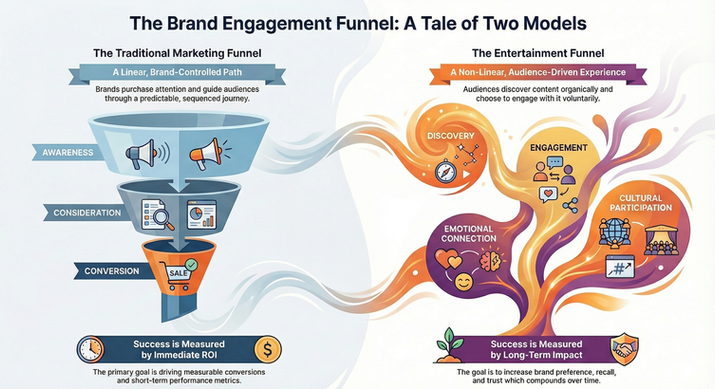
For decades, the marketing funnel has shaped how brands think about growth. Awareness leads to consideration. Consideration leads to conversion. Conversion leads to loyalty. It is linear, measurable, and designed for media environments where brands control distribution.
Entertainment doesn't work this way.
As storytelling and entertainment have moved out of the creative department and into the boardroom, this mismatch has become harder to ignore. Brands are no longer debating whether to invest in entertainment. They are struggling to evaluate it using models built for ads.
When brands force entertainment into the marketing funnel, they optimize for the wrong outcomes, measure the wrong signals, and often walk away too early, wondering why something that worked creatively did not perform commercially.
The problem is the framework.
What the Marketing Funnel Gets Wrong About Entertainment
The traditional marketing funnel is built on a few core assumptions:
-
Brands can buy attention
-
Audiences are reachable on demand
-
Messaging can be sequenced and optimized
-
Performance improves through repetition
This model works when brands purchase media to drive audiences toward a defined action. It breaks down when brands participate in culture.
Audiences choose entertainment because it is compelling. Efficiency, the logic behind media buys, plays no part in that choice.
Audiences do not move through entertainment on a predictable path. They discover it. They sample it. They abandon it. They return to it. They share it. Sometimes months or years later.
That behavior does not map cleanly to an ad funnel, and trying to force it to is where many brands go wrong.
Branded Entertainment Compounds Over Time
One of the most common mistakes brands make is asking entertainment to behave like a direct response channel.
What entertainment actually does is different.
Entertainment builds familiarity.
It builds affinity.
It builds memory.
It builds credibility.
It builds a more human connection.
These effects do not always spike on a media schedule, but they do compound over time.
When brands judge entertainment using short-term performance metrics, they often conclude it is inefficient. In reality, they are measuring it with the wrong ruler.
A ZipRecruiter promotional partnership with the film Ant-Man & the Wasp: Quantumania delivered double-digit lifts in brand love, brand trust, and product affinity. These are metrics that rarely move through standard advertising. The compounding effect is real. The timeline can just take longer than a media cycle.
What Is the Entertainment Funnel?
The entertainment funnel follows audience behavior.
Rather than pushing audiences toward an action, it reflects how people naturally engage with content they choose to watch.
At a high level, the entertainment funnel looks like this:
-
Discovery: Audiences encounter content organically or through recommendation, whether from friends, social platforms, or algorithms.
-
Engagement: They choose to spend time with it. Attention is voluntary, not rented.
-
Emotional Connection: Characters, stories, or moments create resonance. This is where brands earn meaning by association.
-
Cultural Participation: Audiences share, reference, quote, and revisit the content. It becomes part of the conversation.
-
Long-Term Brand Impact: Brand preference, recall, and trust increase over time, often without a single measurable conversion moment.
This is why entertainment rarely shows up cleanly in attribution models but makes a difference in a brand's relevance and staying power.
Where Brands Go Wrong
When brands confuse the marketing funnel and the entertainment funnel, the same mistakes show up repeatedly.
First, they over-optimize creative for messaging instead of story, which weakens the content and limits engagement.
Second, they underinvest in patience, expecting immediate returns from something designed to build over time.
Third, they pull out too early, declaring failure before the compounding effect has had a chance to materialize.
All three are organizational failures.
Brands that understand the entertainment funnel set different expectations, fund projects differently, and measure success more honestly.
How the Four Pillars Map to the Entertainment Funnel
Each of the four pillars introduced in Chapter 1 interacts with the entertainment funnel differently.
Product placement lives primarily in emotional connection and cultural participation. It creates a psychological effect and works best when it's neither too overt nor too subtle, and when it's repeated over time. If you're interested in learning the difference between good and successful product placement, click here.
Storyline integration accelerates engagement and emotional connection by embedding the brand directly into narrative moments.
Promotional partnerships amplify discovery by borrowing attention from entertainment audiences at scale, and when used in advertising, they deliver better outcomes than traditional ads.
Premium brand-funded content spans the entire funnel, from discovery through long-term impact, when executed with discipline and patience.
Understanding this mapping enables brands to choose the right pillar for the right business objective, rather than asking a single tactic to do everything.
Why the Difference Between the Two Funnels Changes Everything
When brands apply the entertainment funnel correctly, several things change.
Creative decisions improve because the goal is resonance, not repetition.
Measurement becomes more honest by focusing on indicators such as recall, affinity, and engagement.
Budgets become more strategic, allocated with an understanding that entertainment is an investment, not a media buy.
Most importantly, brands stop asking entertainment to justify itself using the wrong language and start evaluating it against the outcomes it is actually designed to produce.
How Brands Should Measure Entertainment Investment
The future of brand growth is about recognizing where marketing ends and entertainment begins.
Brands that continue to force entertainment into a marketing framework will struggle to unlock its full value.
Brands that adopt an entertainment mindset will build relevance that outlasts any campaign.
Where This Leads Next
If Chapter 1 defines the tools and Chapter 2 defines the mindset, the next chapters address execution.
In Chapter 3, we examine product placement in detail, not as a relic of the past, but as a discipline that has evolved and grown more powerful as advertising has lost its grip.
Who This Chapter Is For
-
Brand leaders evaluating entertainment investments
-
CMOs struggling to measure content performance
-
Marketing teams applying performance logic to cultural work
-
Studios and creators partnering with brands
Chapter 2 is the turning point of The BRANDVIEW Playbook.
It explains why brands struggle with entertainment even when they believe in it, reframes success in a way that aligns with how audiences actually behave, and sets up every executional chapter that follows.
You can revisit Chapter 1, learn about the history of branded entertainment, and
subscribe to receive future chapters.